May 11, 2016

Craters – Not Cracks – Are Finally Emerging at ICICI Bank

ICICI BANK monthly charts
The bank’s shocking performance in the last financial year should raise serious questions about its management


ICICI Bank, India’s largest private sector bank by assets, posted shocking results for the quarter ended March 31, 2016. The consensus analyst forecast for the bank’s net profit was Rs. 3,100 crores; the bank reported a paltry Rs. 702 crores. This was an annual decline of 76% (compared to Rs. 2,922 crores in 4QFY2015) and a quarterly decline of 77% (Rs3,018 crores in 3QFY2016).

In fact, the results were far worse than the reported numbers suggest.

Overall profits were inflated by including exceptional items – Rs. 2,131 crores of profits on sale of part of ICICI Bank’s shareholding in ICICI Prudential Life Insurance and ICICI Lombard General Insurance, and a deferred tax asset of Rs. 2,200 crores. These items in effect considerably negated the impact of the special provision of Rs. 3,600 crores. Excluding these two items, ICICI Bank has posted a huge loss for the quarter. The stock market penalised the bank, and the stock closed at Rs. 215 on May 5, a decline from Rs. 240 on April 28. With that, ICICI Bank lost its position as the second largest private sector bank by market capitalisation to Kotak Mahindra Bank.

ICICI Bank also finally reported that it had Rs. 44,000 crores “below investment grade” in power, iron and steel, mining, cement and rigs sectors. This was in addition to its net non-performing loans of Rs. 12,963 crores and net restructured standard loans of Rs. 8,573 crores. The bank expects its future non-performing loans to emerge from the category of below investment grade.

Read more at http://thewire.in/2016/05/09/craters-not-cracks-are-finally-emerging-at-icici-bank-34601

Insurance scams - loans at 5% - a must read

So, the other day, I received a routine junk call from a Delhi-based number. But the man at the other end of the line didn’t start with the usual “Sir, are you looking for a loan?” spiel.

Instead, he asked: “Sir, I can offer you a loan at 4.99%. Interested?” He got my attention.

How could he possibly offer me a loan at 4.99% I wondered? “If I take a loan from you at that rate and deposit it in my Savings Bank account, I’ll get double the interest rate. What’s the catch?” I asked of him.

“Nothing,” he said. “I am from the Future Group founded by Kishore Biyani. It’s a two day offer and we’re doing it to attract new clients to whom we can cross sell other products later from our portfolio,” he said, sounding rather earnest.

Having spent two decades in business journalism, I know if something sounds too good to be true, it can’t be true. I ended up engaging with him in an hour-long conversation.

Read complete article at http://www.foundingfuel.com/article/a-day-in-the-life-of-india

May 10, 2016

Neowave analysis for week starting 9th MAY

In the coming week, due to its oversold nature, we may watch if another contrary trade is possible, but on the +ve side.

If the post-Budget rally is indeed a “Diamond-Shaped” Diametric, then the upward g-leg can completely retrace the f-leg
 of fall, and achieve new heights for the rally.
However, since f-leg turned arithmetically “bigger” than the d-leg, it is possible that the post-Budget rally may be turning into a 9-legged Symmetrical Formation, similar to what we saw inside the 1st x-wave (or “B” wave of our alternate Expanding Triangle possibility).

As one can seen after higher highs till e-leg, the Symmetrical formation inside 1st x-wave showed lower highs for g & i legs. 

Symmetrical formation, as a result, can look like a “Rounding Top”
 similar to what we saw during Jul-Aug’15 last year. The last leg of this pattern would be i-leg, and the faster retracement of the last leg would confirm completion of the pattern.
If it indeed turns out to be a Symmetrical Formation, (instead of “Diamond-Shaped” Diametric), then 3 more legs, g-h-i, are pending. Thus, Symmetrical formation could stretch the end-point of the rally further.
Remember, the Symmetrical formation we saw earlier was from 15th Jun’15 to 20th Aug’15, i.e. it formed over 48 trading sessions. Against this, the current post-Budget rally has consumed 43 days. 
By our alternate Expanding Triangle (ET) assumption for the rally, the post-Budget rally is considered as “D” of ET. The “D” leg is already “bigger” than “B” leg price-wise. Ideally, it should be “bigger” time-wise as well.
Therefore, if it indeed turns out to be a Symmetrical formation, then we cannot rule out the rally would end only after 13thMay’16, after achieving “larger” time as compared to the “B” leg.
In case Index fails to open the much-expected g-leg in the fresh week, then we may assume f-leg is still developing. Remember, in Jul’15 last year, the f-leg had completely retraced the e-leg.


Read more at http://content.icicidirect.com/ULFiles/UploadFile_201659105159.asp

Is Warren Buffett really a big fan of the S&P 500?

Buffett is a big fan of the S&P 500. He has already declared that 90 percent of the money he leaves to his wife will be invested in Vanguard’s S&P 500 index fund. He also wagered a million dollars that Vanguard’s S&P 500 index fund would beat a basket of hedge funds over ten years from 2008 to 2017. (The S&P 500 index fund is currently crushing the hedgies.)

Buffett’s enthusiasm for the S&P 500 is a wee bit odd because he has spent an entire career guided by the investment principles of his teacher, Ben Graham, who can genuinely be called the godfather of active investing. Graham’s investment approach, in a nutshell, is to buy quality companies at a cheap price. That’s the furthest thing from just throwing your money into an S&P 500 index fund.

At the same time, Berkshire’s portfolio is also higher quality than the S&P 500. The companies in Berkshire’s portfolio have an average return on equity of 13.1 percent versus 12 percent for the S&P 500, and Berkshire’s companies’ earnings are less volatile than the earnings of the S&P 500.

Read more at http://www.bloomberg.com/gadfly/articles/2016-05-05/inside-warren-buffett-s-love-affair-with-the-s-p-500

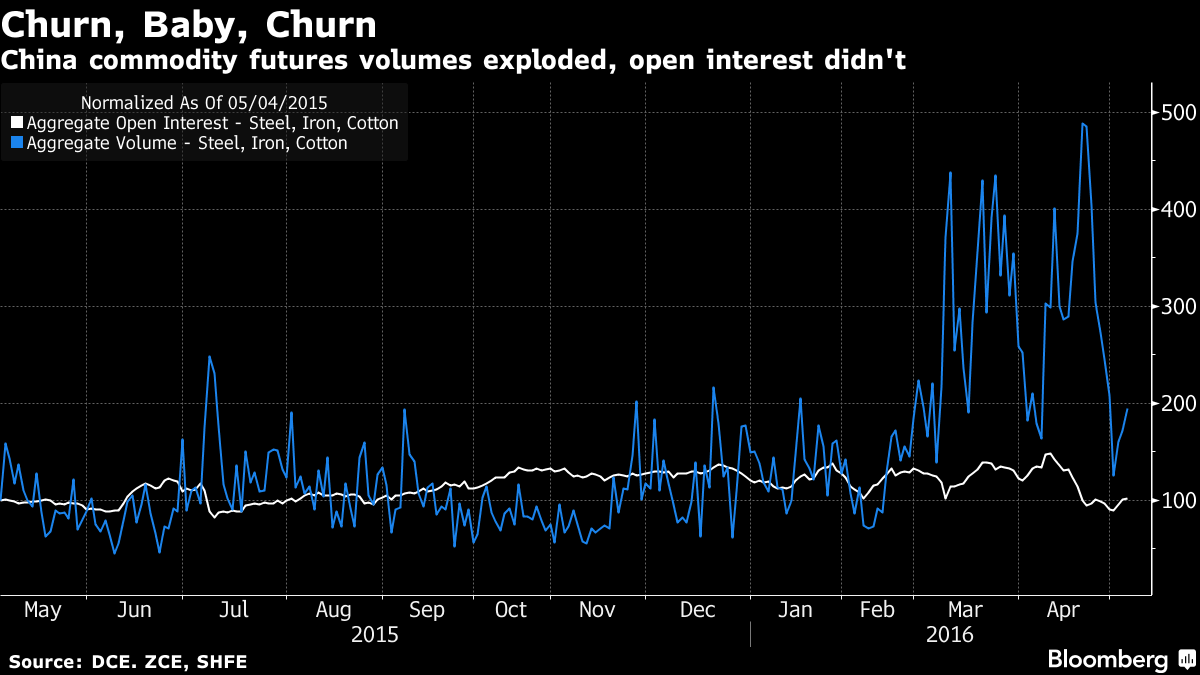
The World's Most Extreme Speculative Mania Unravels in China


From the Dutch tulip craze of 1637 to America’s dot-com bubble at the turn of the century, history is littered with speculative frenzies that ended badly for investors.
But rarely has a mania escalated so rapidly, and spurred such fevered trading, as the great China commodities boom of 2016. Over the span of just two wild months, daily turnover on the nation’s futures markets has jumped by the equivalent of $183 billion, outpacing the headiest days of last year’s Chinese stock bubble and making volumes on the Nasdaq exchange in 2000 look tame.

Thyrocare gains 40% on listing


Thyrocare is the fourth health-care firm in the past six months to see its shares rise more than 30 per cent on listing day. Shares of Dr Lal PathLabs, Alkem Laboratories, and Narayana Hrudayalaya had gained 49.8, 31.6 per cent, and 34.7 per cent, respectively, on listing day. The only health-care firm which had made a dismal debut in the past six months is HealthCare Global Enterprises, whose shares fell 21 per cent on listing day.

Preventive health-care firm Thyrocare's Initial Public Offering (IPO) of shares had generated huge demand last week, with the issue subscribed over 52 times. The Qualified Institutional Buyers (QIB) portion was subscribed 76 times; the non-institutional bidders, or high networth individual (HNI, or the super-rich) portion was subscribed 225 times and the retail (small) quota was subscribed 8.4 times.

Read more at http://www.business-standard.com/article/markets/in-debut-thyrocare-healthier-than-others-116050900780_1.html

India’s stock-market traders missing from tax data

May 9, 2016

Market outlook

EOD charts
- trend is down on daily charts
- support 7700 resistance 8000
- note increasing whipsaws in buy/ sell swings in past month
- today markets up 1.7%, AD positive, VIX down 2%


NSE to launch weekly options contracts on Bank Nifty index

Leading stock exchange NSE today said it will introduce weekly options contracts on Bank Nifty index from May 27.

The decision comes after receiving approval from markets regulator Securities and Exchange Board of India (Sebi).

"The exchange is pleased to inform members that with reference to approval received from Sebi, Weekly Options contracts on Bank Nifty index shall be made available for trading in Future & Options segment with effect from May 27, 2016," National Stock Exchange said in a circular.

It said that Bank Nifty contracts will expire on the every Thursday of week. In case, Thursday is a trading holiday, the contracts will expire on the previous trading day.

"All contracts shall expire at the normal market closing time on the expiry day or such other time as decided by exchange," the bourse said.

A futures contract is a forward contract, which is traded on an exchange, while an option contract gives a person the right but not the obligation to buy or sell something.

An option is a contract between two parties wherein the buyer receives a privilege for which he pays a fee (premium) and the seller accepts an obligation for which he receives a fee.

Link to NSE circular

May 6, 2016

Market outlook + weekly charts

Weekly charts
- NF has formed expanding triangle
- sustaining above this will be bullish
- so far no sign of fast reversal
- holding 7500 will be bullish
- subjective to 7500 holding this year, retest of all time highs possible.


May 5, 2016

MCDOWELL breakout?


HDFC bullish if it can sustain above 1180-1200


GODFRYPHLP breaks this year's low


DISHMAN closes below last month's low


ABGSHIP down 10%; stock at lifetime, 52 week low


Market outlook

EOD charts
- trend is down on EOD charts
- expecting good support around 7500
- resistance 8000


Major mistakes novice investors make


Some insight on how Indian GDP is calculated: WSJ


Druckenmiller: Get out of the stock market, own gold

Legendary billionaire investor Stanley Druckenmiller told Sohn Investment Conference attendees to sell their equity holdings Wednesday.

"The conference wants a specific recommendation from me. I guess 'Get out of the stock market' isn't clear enough," said Druckenmiller from the conference stage in New York. Gold "remains our largest currency allocation."

The billionaire investor expressed skepticism about the current investment environment due to Federal Reserve's easy monetary policy and a slowing Chinese economy.

"The Fed has borrowed from future consumption more than ever before. It is the least data dependent Fed in history. This is is the longest deviation from historical norms in terms of Fed dovishness than I have ever seen in my career," Druckenmiller said. "This kind of myopia causes reckless behavior."

Read more at http://www.cnbc.com/2016/05/04/druckenmiller-get-out-of-the-stock-market-own-gold.html

Chart:5 Year Returns of Nifty Stocks

Share this...